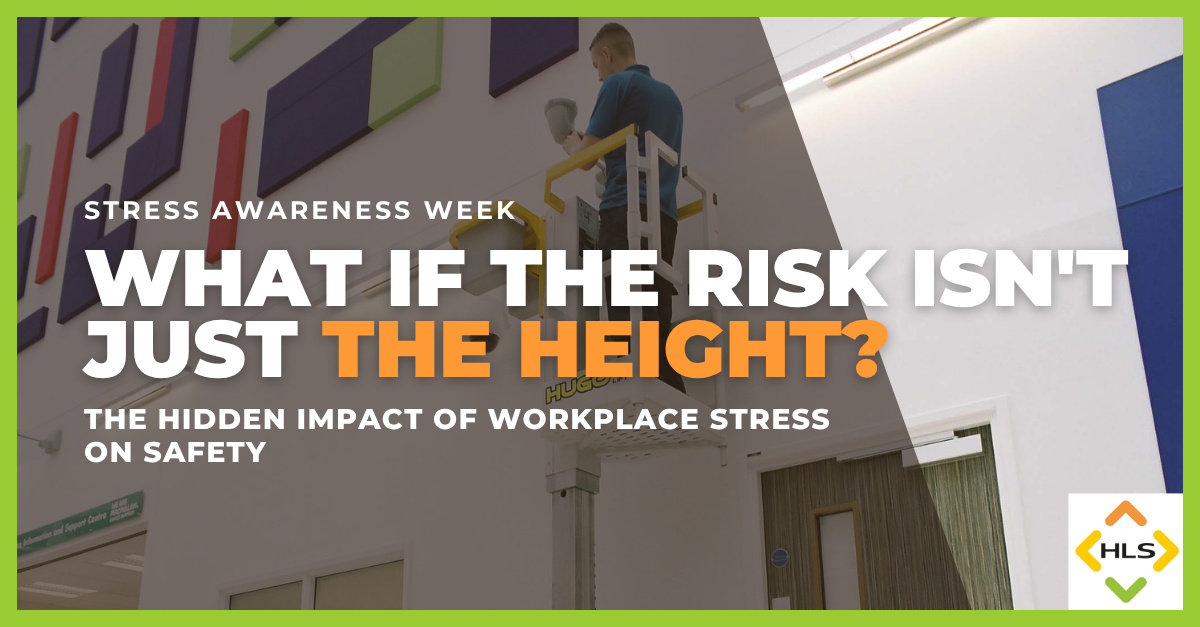



Could workplace stress be putting your team at greater risk when working at height?
Yes, workplace stress can contribute to accidents when working at height by affecting concentration, judgement, communication and awareness of hazards. When employees are dealing with heavy workloads, tight deadlines or poor planning, these pressures can make it more difficult to maintain safe working practices.
This year's International Stress Awareness Week (2–6 November 2026) focuses on "Shaping the Future of Stress and Wellbeing: Rehumanising the Workplace."
The theme highlights the importance of creating working environments where people feel supported, listened to and valued. But it also raises an important question for organisations responsible for workplace safety.
Are we giving employees the time, support and resources they need to work safely?
For facilities management, maintenance and estates teams, unexpected breakdowns, urgent repairs, competing priorities and compliance responsibilities can all contribute to workplace pressures.
While organisations rightly focus on equipment, training and risk assessments, the wellbeing of the people carrying out the work deserves just as much attention.
During Stress Awareness Week, we are exploring how workplace stress can affect working at height safety, what recent LinkedIn polls reveal about operational challenges and how employers can create safer, more supportive working environments.
How Does Stress Affect Working at Height Safety?
Stress can affect a person's ability to concentrate, process information and make decisions, all of which are important when carrying out tasks at height.
When employees experience prolonged or excessive workplace pressure, they may experience:
- Reduced concentration: Difficulty maintaining focus on the task and surrounding hazards.
- Poor decision-making: Greater difficulty assessing situations and selecting appropriate actions.
- Increased fatigue: Feeling mentally or physically exhausted, potentially affecting alertness.
- Reduced hazard awareness: Overlooking changes in the working environment or important safety considerations.
- Communication difficulties: Missing or misunderstanding important instructions and safety information.
- Increased distraction: Finding it harder to prioritise tasks when dealing with competing demands.
For some activities, these effects may lead to errors or reduced productivity. However, when working at height, mistakes can have serious consequences.
Imagine a maintenance engineer carrying out routine lighting repairs in a busy hospital.
They have already been called away to deal with an unexpected breakdown, their planned work is running behind schedule and another urgent request has just come through.
Under increasing pressure, they may feel tempted to rush the remaining work.
Could this affect the time they spend reviewing the task, assessing hazards or checking their access equipment?
Potentially, yes.
This is why workplace stress should be considered alongside other human factors that can influence safety-critical activities.
What Does the HSE Say About Work-Related Stress?
The Health and Safety Executive (HSE) recognises work-related stress as an important workplace health and safety issue.
Employers have a legal duty to assess the risks of work-related stress and take appropriate action to manage them.
The HSE identifies six areas of work design that can contribute to stress if they are not managed effectively:
-
Demands: Workload, working patterns and the working environment.
-
Control: How much influence employees have over the way they carry out their work.
-
Support: The resources, encouragement and guidance employees receive.
-
Relationships: How colleagues and managers interact and support one another.
-
Role: Whether employees understand their responsibilities and what is expected of them.
- Change: How workplace changes are managed and communicated.
These factors can be particularly relevant to facilities management and maintenance teams, where employees often balance routine responsibilities with unexpected requests.
For example, having the appropriate working at height equipment and training is essential, but employees also need sufficient time, clear instructions and support to complete tasks safely.
Managing workplace stress therefore involves more than encouraging individuals to cope with pressure. Employers should also consider how work is organised and whether employees have the resources needed to carry out their responsibilities.
Further reading: HSE guidance on work-related stress
Can Poor Planning Increase Workplace Stress and Working at Height Risks?
Yes. Poor planning can increase workplace stress by creating unnecessary time pressures, disrupting schedules and making workloads more difficult to manage.
But how much of a challenge is poor planning for facilities management teams?
In a LinkedIn poll conducted within the Facilities Management Group, 73% of 469 respondents identified poor planning as the biggest disruption to productivity.
The results were:
- Poor planning: 73%
- Breakdowns: 16%
- Unsuitable equipment: 5%
- Waiting for training: 3%
Although the poll measured perceived productivity challenges rather than workplace stress, the findings highlight how significantly poor planning can affect daily operations.
When maintenance activities become reactive rather than planned, employees may find themselves juggling multiple tasks, responding to urgent requests and working to increasingly tight deadlines.
For those carrying out work at height, this can be particularly concerning.
Insufficient planning may reduce the time available to:
- Complete or review a working at height risk assessment.
- Identify hazards associated with the task and environment.
- Select suitable access equipment.
- Carry out necessary pre-use equipment checks.
- Coordinate activities with colleagues or contractors.
- Establish appropriate emergency and rescue arrangements.
Under the Work at Height Regulations 2005, work at height must be properly planned, appropriately supervised and carried out by competent people.
Effective planning is not simply about completing tasks on schedule. It is about making sure employees have the time, equipment and support needed to carry out their work safely.
Taking a more proactive approach to maintenance can help organisations manage competing priorities without compromising essential safety measures.
Why Is Employee Involvement Important in Working at Height Risk Assessments?
One of the key messages behind rehumanising the workplace is the importance of listening to employees and involving them in decisions that affect their working lives.
This is particularly relevant when assessing workplace risks.
After all, who understands the everyday challenges of a task better than the people regularly carrying it out?
In another LinkedIn poll within the Facilities Management Group, 243 respondents were asked which people-related risk assessment mistake they encountered most frequently.
The results showed:
- Staff not involved: 35%
- Training gaps: 24%
- Risk assessments not shared with the team: 20%
- No team input: 19%
A lack of employee involvement received the highest proportion of votes.
These findings highlight the importance of ensuring risk assessments are not simply completed as a paperwork exercise.
Consider an engineer who regularly carries out maintenance in a restricted plant room.
They may know about access limitations, obstacles or equipment difficulties that are not immediately apparent to someone assessing the task from an office.
By involving employees in the process, organisations can gain a better understanding of the practical challenges involved.
This may help identify:
- Unsuitable access equipment.
- Hazards specific to the working environment.
- Training or familiarisation requirements.
- Changes to existing working conditions.
- Workload pressures that could affect safe working practices.
More importantly, involving employees demonstrates that their knowledge, experience and concerns are valued.
A risk assessment should not just tell employees how to work safely. It should also provide an opportunity for them to contribute to how risks are managed.
Download the HLS Risk Assessment Form
If Safety Comes First, Why Do Workplace Pressures Remain a Challenge?
Safety should always be a priority, particularly when employees are carrying out potentially hazardous activities.
But when multiple urgent tasks arise, how do facilities management teams decide what to tackle first?
In another Facilities Management Group LinkedIn poll, respondents were asked how they prioritised work orders during particularly busy periods.
93% selected prioritising safety issues first.
This is an encouraging finding, suggesting that the respondents recognised the importance of addressing safety-related concerns.
However, when considered alongside the other polls, it raises an interesting question.
If safety is the priority, why do poor planning and employee involvement remain such significant challenges?
Although the polls asked different questions and cannot establish a direct relationship between the results, they highlight issues worth exploring.
Recognising safety as a priority is one thing. Having the time, resources and support to maintain safe working practices is another.
For example, an engineer may understand the importance of inspecting access equipment before use, but unexpected breakdowns and urgent requests can still increase pressure throughout the working day.
This is where workplace culture becomes particularly important.
Employees should feel confident raising concerns, questioning unrealistic deadlines and stopping work when conditions are unsafe.
Creating a supportive working environment means ensuring that safety expectations are reflected in everyday decisions, not just written policies.
What Does Rehumanising the Workplace Mean for Working at Height Safety?
Rehumanising the workplace means recognising employees as individuals with different needs, experiences and challenges, rather than simply focusing on productivity and completed tasks.
For organisations responsible for working at height, this means creating an environment where employees feel listened to, supported and able to raise concerns without fear of negative consequences.
Consider an employee who explains that a maintenance task cannot be completed safely with the equipment available.
Would they feel comfortable raising that concern? Would their manager listen? Would they be given the time and resources needed to find a suitable solution?
These are important questions for any organisation reviewing its safety culture.
Putting people first means:
- Listening to concerns: Taking employee feedback about workloads, equipment and working conditions seriously.
- Encouraging participation: Involving employees in risk assessments and decisions that affect their safety.
- Setting realistic expectations: Allowing adequate time for work to be planned and completed safely.
- Providing appropriate resources: Ensuring employees have access to suitable equipment, training and supervision.
- Supporting open communication: Creating a working environment where people can raise safety and wellbeing concerns.
- Recognising individual needs: Understanding that workplace pressures can affect employees differently.
These measures can help organisations build a more supportive workplace while strengthening their approach to safety.
Because putting people first means more than asking how they are feeling. It also means considering whether the way work is organised allows them to carry out their jobs safely.
How Can Employers Reduce Workplace Stress and Improve Working at Height Safety?
Employers can support safer working practices by reviewing both the physical risks associated with working at height and the organisational pressures affecting employees.
Here are six practical areas to consider.
1. Improve Planning and Reduce Unnecessary Pressure
Where possible, schedule routine maintenance in advance and allocate sufficient time for tasks to be completed safely.
Effective planning helps employees prepare for work, review hazards and organise appropriate equipment before starting.
It can also help minimise disruption from avoidable equipment problems and last-minute arrangements.
HLS offer a Planned Maintenance and Service Agreements for your convenience
2. Involve Employees in Safety Decisions
Encourage employees to contribute to risk assessments, report hazards and share suggestions for improving working practices.
The people carrying out tasks often have valuable knowledge about the equipment, environment and challenges involved.
Listening to this feedback can help organisations identify risks that may otherwise be overlooked.
3. Review Access Equipment Suitability
Using equipment that is suitable for the task and environment is essential for safe working at height.
For routine maintenance activities, organisations may benefit from reviewing whether ladders remain the most appropriate option.
Depending on the application, alternatives can include:
- Low-level access platforms.
- Platform steps.
- Push-around vertical mast lifts.
- Scissor lifts.
- Mobile vertical mast lifts.
- Other Mobile Elevating Work Platforms (MEWPs).
For example, the HLS Hugo Lift is a compact push-around vertical mast lift designed for suitable indoor work at height. Its enclosed working platform and height-adjustable cargo shelf can support activities such as maintenance, cleaning and stock picking.
A Ladders Last approach encourages organisations to consider whether more suitable access equipment is available rather than automatically choosing a ladder.
However, equipment should always be selected according to the task, environment and findings of the risk assessment.
4. Provide Appropriate Training and Support
Employees should have the knowledge, skills and experience required to carry out their work safely.
Depending on their role and responsibilities, this may include:
Appropriate training helps employees understand equipment limitations, identify hazards and follow safe working procedures.
However, training should be supported by adequate supervision, clear communication and realistic expectations.
5. Keep Equipment Maintained and Available
Unexpected equipment failures can create additional disruption and increase pressure on maintenance teams.
Regular servicing and preventative maintenance can help identify developing problems, improve equipment reliability and reduce avoidable downtime.
Where applicable, LOLER thorough examinations and other required inspections also support equipment safety and legal compliance.
Taking a planned approach to maintenance helps organisations manage equipment availability more effectively.
6. Encourage Open Conversations About Workplace Stress
Employees should feel comfortable discussing workload pressures, wellbeing and concerns about working conditions.
Managers can support this by checking in regularly, listening to feedback and taking action where working arrangements are creating unnecessary stress.
This is particularly important when employees feel that limited resources, unrealistic deadlines or competing priorities could affect their ability to work safely.
Frequently Asked Questions
- Does Workplace Stress Increase the Risk of Accidents?
Workplace stress can contribute to accident risk by affecting concentration, decision-making, communication and hazard awareness. During safety-critical activities, including working at height, these effects may increase the likelihood of errors, particularly when combined with inadequate planning or other workplace hazards.
- Can Poor Planning Cause Workplace Stress?
Yes. Poor planning can contribute to workplace stress by creating uncertainty, increasing workloads and introducing unnecessary time pressures. For facilities management teams, reactive maintenance and changing priorities can make tasks more difficult to organise.
- Why Is Planning Important When Working at Height?
Planning helps ensure that hazards are identified, risks are assessed, suitable equipment is selected and appropriate safety measures are in place before work begins. The Work at Height Regulations 2005 require work at height to be properly planned.
- What Are Human Factors in Health and Safety?
Human factors are the organisational, environmental and individual influences that affect workplace behaviour and performance. These include stress, fatigue, workload, communication, competence and supervision.
- How Can Employers Support Employee Wellbeing and Workplace Safety?
Employers can support wellbeing and safety by managing workloads, involving employees in decisions, encouraging open communication, providing suitable equipment and ensuring appropriate training and supervision. They should also assess work-related stress risks and take action to address identified concerns.
Supporting Safer Working at Height with HLS
Creating safer working environments involves more than meeting compliance requirements.
It means ensuring employees have the right equipment, appropriate training and practical support to carry out their responsibilities safely.
At HLS, we work with organisations across facilities management, healthcare, education, manufacturing, data centres, and other sectors to help them review and manage their working at height requirements.
Whether you're reviewing a Ladders Last policy, exploring alternatives to ladders, arranging IPAF training or looking for support with access equipment hire, contract rental, servicing or LOLER thorough examinations, our team can help.
Looking to review your working at height arrangements?
Contact HLS to discuss your requirements and explore suitable working at height solutions.
The Bottom Line: Safer Workplaces Start with People
International Stress Awareness Week 2026 reminds us that creating healthier workplaces starts with recognising the people behind the work.
For facilities management and maintenance teams, workplace stress is not just a wellbeing consideration. It can also influence how tasks are planned, communicated and carried out.
The findings from our LinkedIn polls highlight some of the operational challenges facing professionals, including poor planning, limited employee involvement in risk assessments and competing priorities.
Although these findings do not directly measure workplace stress or accident rates, they reinforce the importance of considering the human side of workplace safety.
By listening to employees, improving planning, managing workload pressures and providing suitable equipment and training, organisations can help create working environments where people feel supported and safety remains a priority.
Because a safer workplace is not just one where employees know how to work safely. It is one where they are given the time, resources and support to do so.