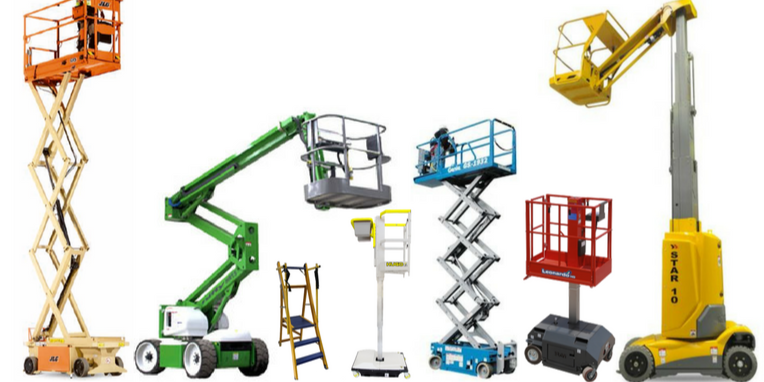


A MEWP is a type of working at height equipment designed to safely lift people, tools and materials to elevated work areas. Common examples include scissor lifts, cherry pickers, boom lifts, vertical mast lifts and spider lifts.
At HLS, we spend every day helping businesses find safe, practical solutions for working at height. While terms such as MEWP, PAV and boom lift are common within the powered access industry, many people simply want to know which machine is right for their application.
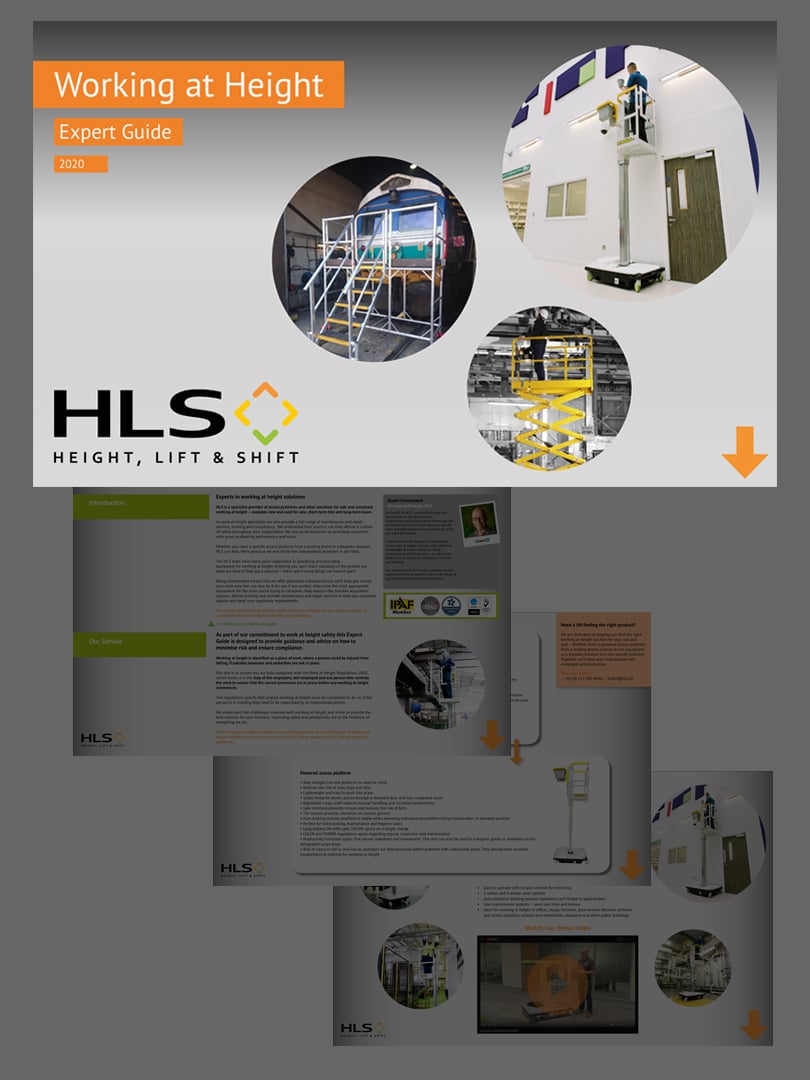
In this guide, we will explain what a MEWP is, the different types of access equipment for working at height available and where they are typically used. If you're researching different types of working at height equipment, explore our HLS Working at Height Expert Guide for a broader overview of the solutions available.
What is a MEWP?
In the simplest terms possible, a MEWP is a Mobile Elevating Work Platform. Essentially, a MEWP is a platform, usually powered, designed to help one or more people carry out work safely at height.
MEWPs are widely used whenever people need to work beyond their natural reach from ground level. They provide a safer and more productive way to access elevated work areas and are commonly used for maintenance, inspections, installations and repair work.
Across sectors such as data centres, healthcare, facilities management, general manufacturing, food and drink manufacturing, warehousing and education, MEWPs help organisations complete work at height safely and efficiently.
MEWPs are often referred to by a variety of different names, depending on the type of machine and its application.
Types of MEWPs and Access Platforms
Access Platforms
Scissor Lift or Magic Carpets
Scissor lifts are large mobile vertical lifts, sometimes referred to as "flying carpets". They are ideal for a variety of indoor and outdoor applications where straight vertical access is required.
Although narrow-width models are available, scissor lifts typically offer a larger platform area than other forms of working at height equipment, making them ideal where operators need space for tools and materials. They are also available with rough-terrain capabilities and extending decks.
Scissor lifts meet the requirements of the Work at Height Regulations through the use of enclosed platforms and guardrails, helping organisations carry out work safely at height.
Boom Lifts and Cherry Pickers
Articulating boom lifts, more commonly known as cherry pickers, offer an extensive range of movement.
Their horizontal outreach allows operators to work around and over obstacles such as plant equipment, machinery, production lines and building infrastructure. This makes them a practical solution for both indoor and outdoor applications.
Available in a range of working heights and configurations, articulating boom lifts are among the most versatile forms of access equipment for working at height.
Stick Booms
Stick booms, also known as telescopic boom lifts, offer significant working height and horizontal outreach.
Their straight boom design allows operators to access elevated areas quickly and efficiently, making them ideal for manoeuvring around and above obstacles, machinery and buildings.
Many models are available with four-wheel drive and rough-terrain capability, making them suitable for demanding environments.
Vertical Mast Lift
Push-around vertical platforms, often referred to as PAVs or personnel lifts, are compact machines designed for low-level access applications.
PAVs are particularly popular in data centres, schools, healthcare environments, warehouses and manufacturing facilities where space is restricted and access routes are narrow.
Their compact footprint allows them to navigate aisles, doorways and passenger lifts, making them a practical alternative to ladders and steps for many indoor working at height tasks.
Spider Lifts and Tracked Booms
Spider lifts, also known as tracked booms, provide both outreach and vertical access across a wide range of environments.
With the ability to level the machine using stabilisers, they can operate safely on uneven or sloping ground. Their compact dimensions also allow many models to pass through narrow entrances before being deployed.
These highly versatile platforms are frequently used for facilities management projects, building maintenance, atrium access and applications where access is restricted.
How to Choose the Right Working at Height Equipment
Not all MEWPs are suitable for every application. Choosing the right access equipment for working at height depends on several factors, including:
- Working height required
- Horizontal outreach requirements
- Indoor or outdoor use
- Ground conditions
- Site access restrictions
- Number of operators
- Weight of tools and materials
For example, a scissor lift may be ideal where straight vertical access is required, while an articulating boom lift may be better suited to reaching over obstacles. Spider lifts can provide an effective solution where access is restricted or ground conditions are uneven.
For organisations comparing different types of working at height equipment, it is important to consider not only working height but also access routes, operator requirements, site conditions and safety procedures. A thorough site risk assessment should always be carried out before selecting equipment to ensure the safest and most productive solution is chosen.
Frequently Asked Questions
- What does MEWP stand for?
MEWP stands for Mobile Elevating Work Platform.
- Is a cherry picker a MEWP?
Yes. A cherry picker is a type of MEWP, typically an articulating boom lift that provides both height and outreach.
- Is a scissor lift a MEWP?
Yes. Scissor lifts are one of the most common categories of MEWP and are designed primarily for vertical access.
- What is the difference between a boom lift and a scissor lift?
A scissor lift provides straight vertical access, while a boom lift provides both height and horizontal outreach, allowing operators to reach over obstacles and access difficult-to-reach areas.
- Do you need training to operate a MEWP?
Yes. Operators should receive appropriate training before using a MEWP. IPAF training is one of the most widely recognised powered access qualifications in the UK.
Need Help Choosing the Right MEWP?
The important thing to remember is that MEWP is a generic term covering a wide range of working at height equipment. From scissor lifts and cherry pickers to spider lifts and vertical mast lifts, each machine is designed to provide safe and efficient access for different tasks and environments.
MEWPs are used throughout data centres, healthcare facilities, educational environments, facilities management operations, food and drink manufacturing plants, general manufacturing sites, warehouses and commercial properties, helping organisations carry out work at height safely while improving productivity and efficiency.
Whether you're carrying out routine maintenance, upgrading infrastructure, inspecting equipment or looking for a safer alternative to ladders, there is likely a MEWP suited to your requirements
If you are unsure which access platform is right for your application, the HLS team can help. Contact us on +44 (0)113 524 1018 or get in touch via our website to discuss your working at height requirements.