




Working at height is part of everyday life for many teams across manufacturing, data centres, facilities management, aviation, defense and many more sectors. Operating a MEWP, installing lighting or carrying out maintenance at height can start to feel routine.
But routine does not mean risk-free.
In fact, falls from height remains one of the leading causes of serious workplace fatal injuries in the UK. That is why a well-conducted risk assessment is not just a paperwork exercise, it is a structured way to slowdown, challenge assumptions and make safer decisions before the job begins.
In this second blog of our risk assessment campaign, following our discussion on generic vs site-specific assessments, we will walk you through how to carryout a risk assessment step by step, while also exploring the human side of risk: how perception, pressure and experience influence the decisions we make on site.
Why Risk Assessment Matters More Than Ever
Under the Health and Safety at Work etc. Act 1974, employers have a legal duty to protect the health, safety and welfare of their employees and others affected by their work.
But beyond legal compliance, effective risk assessment supports a much bigger goal:
Delivering a healthy workforce and a healthy economy.
With national strategies increasingly focused on preventing work-related ill health and supporting sustainable growth, organisations in 2026 and beyond are expected to take a proactive role in reducing workplace risk, not just reacting to incidents after they occur.
And it starts with understanding the difference between a hazard and a risk.
Hazard vs Risk: What is the Difference?
- Hazard: The potential for harm (e.g. working near live overhead power lines).
- Risk: The likelihood that harm could occur, combined with the severity of that harm.
A workplace risk assessment examines the relationship between:
- The worker
- The task
- The equipment
- The environment
It identifies uncontrolled hazards and puts sensible control measures in place to reduce risk to an acceptable level.
The 5 Steps to Conduct a Risk Assessment
1. Identify the Hazards
Start by walking the work area and asking a simple question:
What could realistically cause harm here?
Common hazards when working at height include:
- An untrained and/or non-familiarized operator
- Overhead obstructions during use
- Energized conductors, power lines or electrical hazards
- Other moving equipment or vehicles in the work area
- Overloading the platform
- Other personnel working in the same area
- Unusual operating conditions
- Unauthorised use
- Faulty or defective controls
- Inadequate ground support
- Debris, such as tree branches, workplace materials, cords, etc.
- Wear, problems or malfunctions with the equipment
- Wind and weather conditions
- Improper equipment selection
But here is where it gets interesting.
When we work in the same environment every day, we stop “seeing” certain hazards. Familiarity creates blind spots. Someone who has used MEWPs for years without incident may subconsciously believe serious accidents are unlikely.
This is where human factors come into play:
- Anchoring – “The ground was fine yesterday.”
- Availability bias – “I have never seen a MEWP overturn.”
- Representativeness – “We have done this job before without issues.”
A good risk assessment forces you to pause and reassess, today’s conditions, not yesterdays.
No Falls Week: Preventing Falls from Height blog: Read here
Practical tips for identifying hazards:
- Walk the area with fresh eyes
- Involve operators and supervisors
- Review accident and near-miss records
- Check manufacturer guidance
- Consider long-term health risks (noise, vibration, substances)
Sometimes the most valuable insight comes from asking your team:
“What worries you most about this job?”
2. Decide Who Might Be Harmed, and How
Risk assessments are not about listing names, they are about identifying groups of people who could be affected:
- MEWP operators
- Occupants in the basket
- Ground workers
- Contractors
- Visitors
- Members of the public
Consider additional vulnerabilities:
- New or young workers
- Non-English-speaking workers
- Workers with disabilities
- Apprentices or temporary staff
Ask yourself:
- Could someone be struck by moving equipment?
- Could someone fall from height?
- Could someone suffer long-term ill health?
Understanding how harm could occur helps you choose the right control measures.
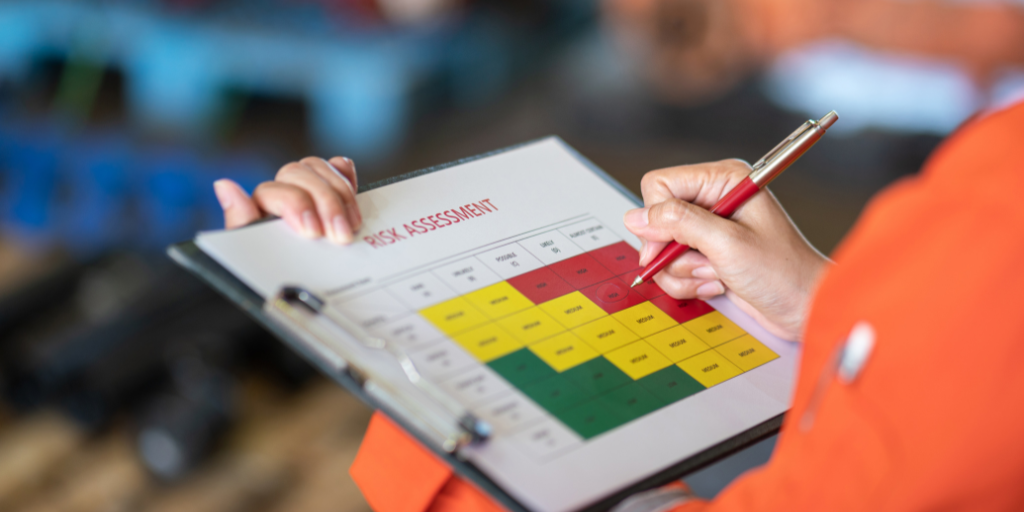
3. Evaluate the Risk and Implement Control Measures
Now assess:
- How likely is this to happen?
- If it did happen, how severe would the outcome be?
Then apply the hierarchy of control:
- Eliminate the hazard
- Substitute with a safer method
- Use engineering controls (guardrails, edge protection)
- Administrative controls (procedures, supervision)
- PPE (harnesses, lanyards)
Example:
Hazard: Debris on warehouse floor
Risk: MEWP instability or overreaching
Control: Clear debris to allow safe access and stable positioning
Effective plans often include:
- Immediate temporary improvements
- Long-term engineering solutions
- Clear responsibilities
- Training and supervision
- Monitoring to ensure controls remain in place
Remember, a control measure only adds value when it is implemented and understood.
That is why communication is critical. Keep instructions simple and practical. If housekeeping is the control, ensure workers have proper storage solutions and understand expectations.
4. Record Your Findings
If you employ five or more people, recording your assessment is a legal requirement.
Your documentation should demonstrate:
- Hazards identified
- Who may be affected
- Evaluation of severity and likelihood
- Control measures implemented
- Remaining level of risk
- Evidence of employee involvement
A structured template ensures consistency and makes future reviews easier.
Good documentation also protects your business, it demonstrates due diligence to clients, insurers and regulators.
5. Review and Update
Workplaces evolve constantly.
Weather changes. Equipment changes. People change.
You should review your risk assessment:
- After an incident or near miss
- When introducing new equipment
- When work methods change
- When conditions shift (e.g. weather)
- At least annually as a formal review
Before starting work, pause and ask:
- Have conditions changed?
- Am I relying on past experience instead of current assessment?
- Am I feeling rushed or fatigued?
- Am I accepting risk I wouldn’t normally accept?
Safe work at height is not just about equipment, it is about slowing down decision-making when it matters most
Leadership, Culture and Accountability
When speaking to senior management about risk, the focus should be on informed decision-making.
Leaders need a clear understanding of:
- The nature of the hazards
- The level of exposure
- The potential consequences
- The effectiveness of current controls
Embedding health and safety into company culture means moving beyond compliance. It means making safety part of everyday operational thinking.
At its core, this is about people, their physical wellbeing, their mental health, and ensuring they return home safely at the end of every shift.
Management credibility depends on visible commitment. When identified hazards are addressed promptly, trust grows. When they are ignored, reporting declines.
A risk assessment is not just a safety tool; it is a leadership tool.
Get Support from HLS
If you are unsure about:
- The right equipment for your task
- Whether your controls are sufficient
- How to carry out a site-specific assessment
- Compliance requirements such as LOLER inspections
HLS can help.
We offer:
Explore our Resources & Insights section or speak to one of our experts for tailored support.
Because when it comes to working at height, the most important question is not “Have we done this before?”
It is “Have we assessed the risk properly, today?”
--------------------------------------------------------------------------------------------------------------------------------
Next in our Risk Assessment Campaign: 10 Common Risk Assessment Mistakes, and how to avoid them.
---------------------------------------------------------------------------------------------------------------------------------
Resources & References
This guide draws on recognised industry best practice and official UK health and safety guidance, including:
- Health and Safety Executive (HSE) – Risk assessment guidance
https://www.hse.gov.uk/simple-health-safety/risk/ - Health and Safety at Work etc. Act 1974
https://www.hse.gov.uk/legislation/hswa.htm - International Powered Access Federation (IPAF) –
Statement of Best Practices for Workplace Risk Assessment and Aerial Work Platform Equipment Selection
https://www.ipaf.org/sites/default/files/2018-02/Best%20Practices%20-%20Risk%20Assessment%20and%20Selection%20%2802-13-AWP-SBP003%29%20EN-US.pdf