

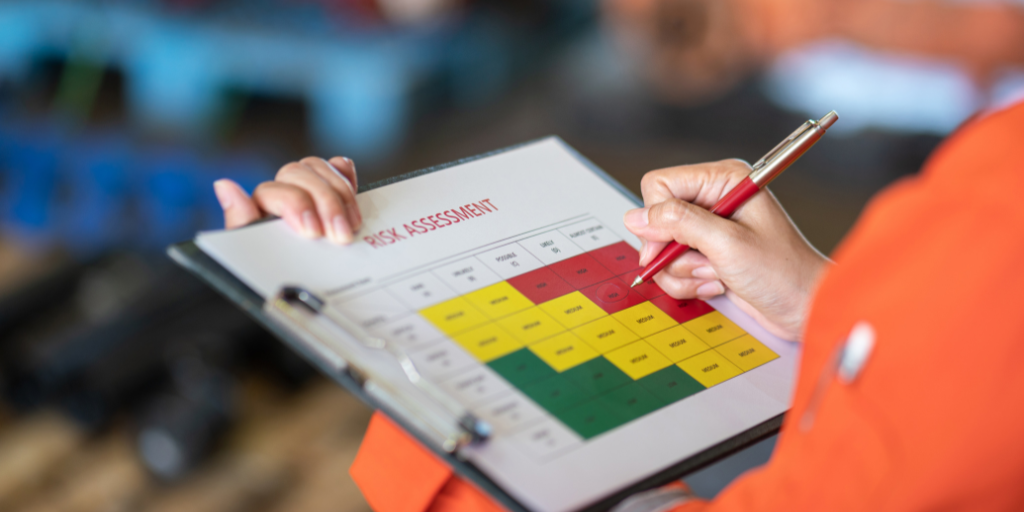




Most organisations today have risk assessments. They are filed, signed, and available when asked for.
The bigger question is whether they reflect what is really happening on site, the layout, the access route, the surrounding jobs, the weather, the public access, and the way the job is actually carried out.
That difference matters. Especially for working at height, where small differences in environment or access can quickly become high-consequence risks.
Recent polling shows that site conditions are the main factor shaping what is written in risk assessments day to day. Previous risk assessments still influence many documents, but factors such as project deadlines and client requirements are far less significant.
This article sets the scene for our risk assessment series by explaining the difference between generic and site-specific risk assessments, why generic documents are still widely used, and how to move toward assessments that genuinely improve safety.
What are generic risk assessments?
A generic risk assessment is a document written to cover a common activity in general terms, such as:
- Working at height using ladders
- MEWP operation
- Loading/unloading materials
- General maintenance activities
Generic assessments typically:
- List common hazards and controls
- Use broad language that could apply to many sites
- Rely on standard control measures and assumptions
- Are built for speed and consistency
They can be useful as a starting reference, especially for organisations building a baseline standard, but on their own they often miss what causes real incidents: the site-specific details. That does not mean that generic risk assessments are bad. They can be very useful when used correctly. But it is important to remember that generic risk assessments are not the finished product.
What makes a risk assessment site-specific?
Site-specific risk assessments identify the hazards that actually exist on a site and assess the risks those hazards create for the task being carried out. They are based on the location, environment, and working conditions at the time of the job, rather than assumptions or previous documents. By focusing on what is relevant to that site, they avoid generic information and help ensure controls match the real risks present.
A site-specific risk assessment is built around the actual job, at the actual location, at that time.
It reflects things like:
- Access and way out routes (including emergency access)
- Edges, openings, fragile surfaces, and ground conditions
- Proximity to other trades, vehicles, pedestrians, or the public
- Weather exposure and seasonal factors
- Site rules, permits, and restrictions
- Equipment selection
- Rescue plan for work at height
A quick test is this:
If you removed the site name and swapped it with another site, would it still be accurate?
If yes, it is probably not site-specific enough.
Are site-specific risk assessments better than generic ones?
In most cases, yes, because risk is shaped by where the work is taking place.
A generic assessment might say “use suitable access equipment.” A site-specific assessment explains:
- Which access equipment is suitable here (and why)
- What constraints affect selection (space, ground bearing, overhead hazards)
- How other site activities change the risk profile
- What the rescue plan is in this exact environment
That said, generic documents are not “bad.” The problem is when they become the main product, rather than the starting point.
Why previous RAMS become the starting point
This is one of the most common reasons assessments drift toward generic.
In day-to-day delivery, teams are often under pressure to:
- Start work quickly
- Provide RAMS to a client at short notice
- Reuse “what worked last time”
- Keep admin time down
So the process becomes:
- Pull up last job’s RAMS
- Make a few edits
- Get it signed
- Get started
That approach can feel efficient, but it lets the previous job shape decisions more than current site conditions.
Why this is especially dangerous for working at height
Working at height is unforgiving because small changes can massively change risk, such as:
- A different access route
- Slightly uneven ground affecting a tower or MEWP stability
- Wind exposure on one elevation vs another
- Other trades working below creating dropped-object risk
- Tight exclusion zones or public interface issues
- A rescue plan that’s copied, but not workable on this site
A generic assessment may still “tick the boxes,” but it will not necessarily prevent the scenarios that cause falls and serious injuries.
How to format an effective Site-Specific Risk Assessment
A strong site-specific assessment is easy to follow and practical for the people doing the work. A simple, effective structure is:
1. Job & Location Details
Site name, area, task description, date, and reviewer.
2. Task / Situation
What is happening, where the task takes place, and the sequence of work.
3. Hazards & Who May Be Harmed
Identified hazards and all persons at risk, including workers, contractors, visitors, and the public.
4. Risk Controls
Control measures in place, using the hierarchy of control where possible.
5. Equipment Selection
Equipment used and justification for its suitability to the task and environment.
6. Emergency & Rescue Arrangements
Specific, realistic, and site-based emergency and rescue procedures.
7. Review Triggers
Changes or events that require this risk assessment to be reviewed.
Examples of site-specific risk assessment detail
Site-specific risk assessments are defined by the quality of detail, not their length. The difference is often in how clearly the assessment reflects the real working environment.
Below are examples showing how small changes in wording can make a significant difference.
Access Equipment and Work Area
Generic:
“Use suitable access equipment and establish exclusion zones.”
Site-specific:
“Work will be carried out using a MEWP positioned within the nominated work area agreed with the site representative. Ground conditions will be checked before positioning. Barriers and warning cones will be used to prevent unauthorised access to the work area and to manage nearby vehicle and pedestrian movement.”
Interaction With Other Site Activities
Generic:
“Be aware of other operatives and vehicles.”
Site-specific:
“The task will be carried out in an area where other operatives and moving vehicles are present. Local plant and vehicle movements will be managed during the work. The engineer will liaise with the site supervisor before starting and if conditions change.”
Equipment Condition and Use
Generic:
“Ensure equipment is safe to use.”
Site-specific:
“Pre-use checks will be completed before operation. Safety systems and emergency controls will be tested prior to use. Equipment will only be operated if it is in good condition and suitable for the working environment.”
Final thought
Generic assessments often exist because they are fast, familiar, and requested. But effective risk management comes from documents that reflect real sites, real conditions, and real work.
Templates are not the problem. Letting the template lead the thinking is.
Next in the series
In our next article, we break it down step by step, how to carry out a risk assessment properly.

.png)
-1.png)